

2026-07-23
Understanding Z-Wave vs. WiFi Smart Locks: The Professional’s Guide to Smart Home Protocols
1.What is a Z-Wave Smart Lock?
Z-Wave smart lock is a wirelessly connected door lock that operates on the Z-Wave protocol—a low-power, sub-1 GHz radio standard built specifically for home automation and access control. Unlike Wi-Fi locks that connect directly to your network and require constant cloud communication, Z-Wave locks communicate through a central hub, which manages internet connectivity and remote access while allowing the lock to conserve power.
Three key advantages distinguish Z-Wave from Wi-Fi smart locks:
- Reliable connectivity: Z-Wave uses dedicated frequency bands, avoiding the crowded 2.4 GHz and 5 GHz spectrums where countless devices compete for bandwidth. Commands are delivered reliably—essential for guest check-ins or emergency access.
- Extended battery life: Z-Wave's low-power design delivers 12 to 24 months of battery life, compared to just 3 to 6 months for Wi-Fi locks. For properties with hundreds of locks, this translates into substantial labor and material savings.
- Scalable network: Z-Wave's mesh networking lets each powered device act as a signal repeater, extending coverage without additional infrastructure. As properties expand, the network grows organically—eliminating costly Wi-Fi access points or network redesigns.
In short, a Z-Wave smart lock is not merely a connected lock—it is a reliable, low-maintenance component for professional-grade access control ecosystems, offering stability and efficiency that Wi-Fi alternatives struggle to match.
2.Connectivity Depth: Z-Wave vs WiFi (Range and Interference)

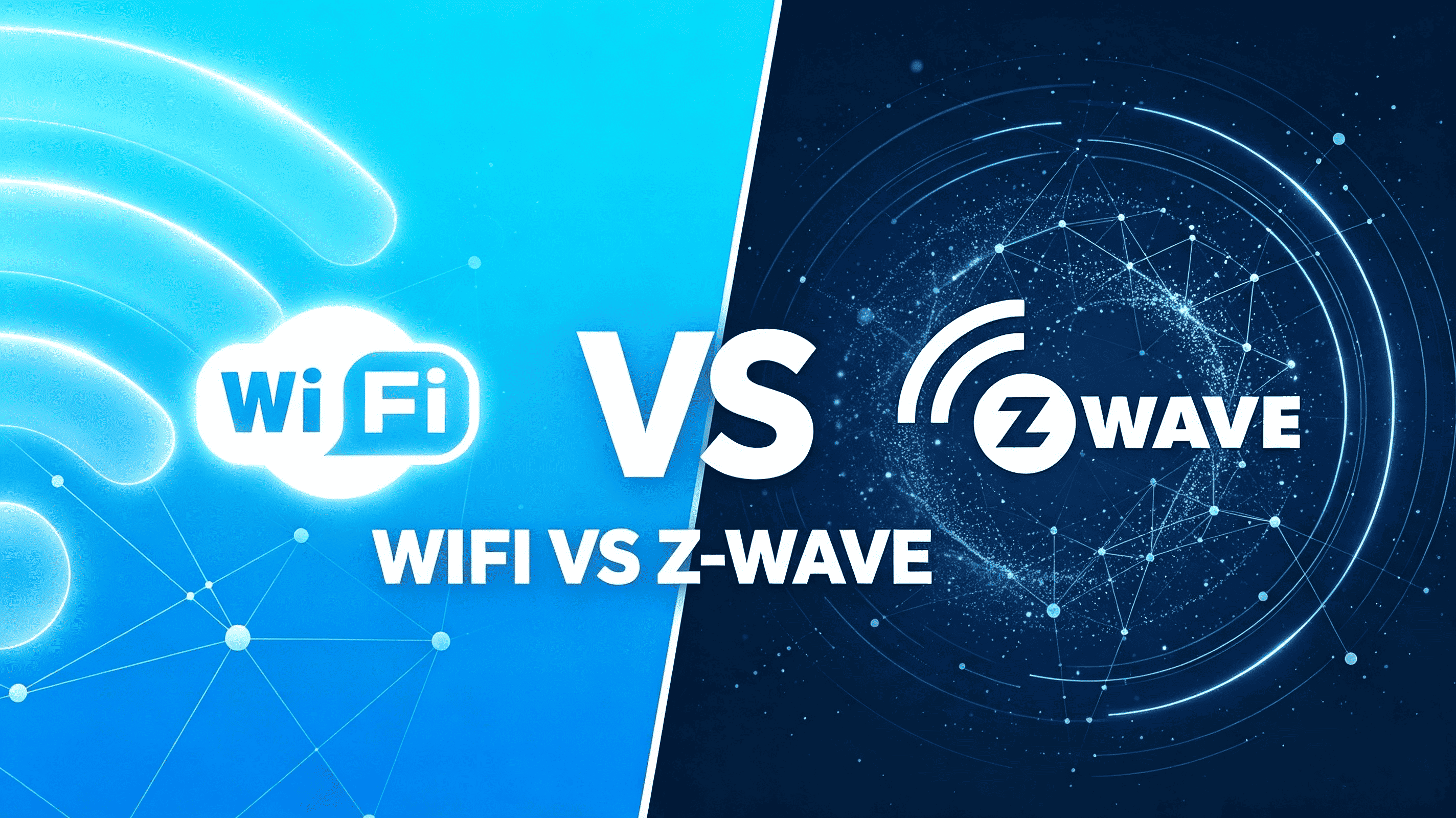
The key difference between Z-Wave and Wi-Fi smart locks lies in connectivity depth—signal reliability in real-world conditions.
Wi-Fi operates at higher frequencies (2.4 GHz / 5 GHz), making it vulnerable to attenuation from concrete, steel, brick, and wood framing. Dead zones are common in multi-story buildings, and extending coverage requires costly additional access points or mesh systems.
Z-Wave operates at sub-1 GHz with longer wavelengths, offering superior penetration through walls, floors, and ceilings. A single hub reaches up to 300 feet in open air, and range scales with each powered device added—no new infrastructure required.
Interference is equally critical. The 2.4 GHz band is overcrowded with Wi-Fi networks, Bluetooth, cordless phones, and microwaves, causing latency and packet loss. Z-Wave's dedicated band remains clear, ensuring reliable command delivery in dense environments.
| Specification | WiFi | ZWave |
| Radio frequency | 2.4 / 5 / 6 GHz | 908 MHz (US) |
| Indoor range | 50 m | 30 m (100 ft) |
| Speed | Up to 600 Mbps (WiFi 4), 1.3 Gbps (WiFi 5), 9.6 Gbps (WiFi 6) | Up to 100kbps |
| Network Topology | Star topology | Mesh network topology |
| Power Consumption | High | Low |
| Ideal Use | High-data applications (streaming, gaming, etc.) | Low-latency tasks in home automation |
For multi-building or large-scale deployments, Z-Wave delivers reliable connectivity with lower cost and fewer interference issues.
3.Mesh Networking Benefits for Large Projects.

Z-Wave's mesh network is a key advantage for large-scale deployments. Every mains-powered device—smart plugs, thermostats, lighting controllers—acts as a signal repeater, forwarding commands between the hub and locks. This creates a self-healing network that automatically reroutes signals if any node goes offline.
For multi-building properties and campuses, this delivers four key benefits:
- Coverage without infrastructure: Strategic placement of powered devices extends range across an entire property—no additional access points, cabling, or gateways required.
- Self-healing: If a repeater fails, the network instantly recalculates the optimal signal path, ensuring uninterrupted lock communication.
- Scalable growth: Each new powered device extends range further. As properties expand, the network grows incrementally—without costly overhauls.
- Lower latency: Signals travel shorter, direct paths through the mesh, improving response times over Wi-Fi's remote routing.
The result: one unified network reaching every door—without the expense and complexity of distributed Wi-Fi infrastructure.
4.Why System Integrators prefer Z-Wave.
For system integrators, protocol choice impacts service calls, client satisfaction, and long-term costs. Here is why experienced integrators prefer Z-Wave:
- Predictable performance: Dedicated spectrum and standardized commands eliminate deployment uncertainty across different building types.
- Lower operating costs: 12–24 month battery life vs Wi-Fi's 3–6 months—significant labor and material savings across hundreds of locks.
- Network independence: Local operation continues even when internet fails—critical for security applications.
- Future-proof: Z-Wave 800 Series delivers longer range, faster pairing, and enhanced security, ensuring long-term relevance.
- Simplified deployment: One hub, one network, hundreds of locks—no per-device Wi-Fi configuration.
For integrators, Z-Wave means reliable, cost-effective access control with fewer service calls.
Conclusion
Z-Wave and Wi-Fi both enable smart locks, but for professional deployments, the differences are critical. Wi-Fi suffers from poor penetration, interference, short battery life, and costly scalability. Z‑Wave delivers reliable connectivity, extended battery life, self‑healing mesh, and lower TCO.
With 13 years of access control expertise, Secukey offers robust Wi‑Fi, Wiegand, and RFID solutions—providing practical alternatives where Z‑Wave may not be the right fit. Choose the protocol that fits your project. Choose Secukey.