

2026-07-09
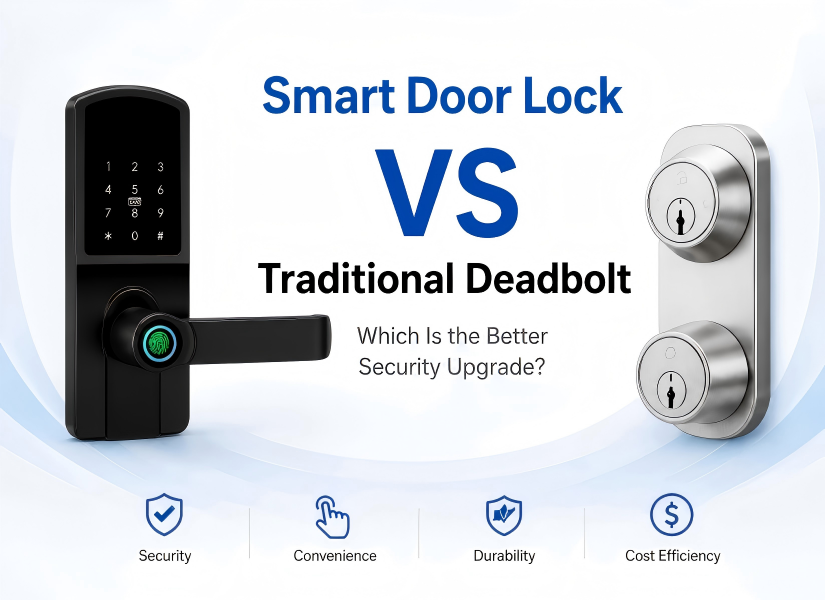
Smart Door Lock vs. Traditional Deadbolt: A Security Upgrade Guide for Wholesalers
Introduction
The global access control market is rapidly evolving as smart homes, commercial buildings, and rental properties adopt connected security solutions.
For wholesalers, importers, and distributors, understanding the difference between smart door locks and traditional deadbolts is essential to stay competitive.
While traditional locks provide reliable mechanical security, modern smart locks offer advanced features such as fingerprint recognition, mobile app control, PIN codes, remote unlocking, and access logs.
This guide explores smart locks vs traditional locks, helping wholesalers understand the benefits of smart security solutions and identify new business opportunities in the growing market.
For wholesalers, importers, and distributors, understanding the difference between smart door locks and traditional deadbolts is essential to stay competitive.
While traditional locks provide reliable mechanical security, modern smart locks offer advanced features such as fingerprint recognition, mobile app control, PIN codes, remote unlocking, and access logs.
This guide explores smart locks vs traditional locks, helping wholesalers understand the benefits of smart security solutions and identify new business opportunities in the growing market.
1. Security Analysis: Smart Door Lock vs Traditional Lock
|
Feature
|
Traditional Deadbolt
|
Smart Door Lock
|
|---|---|---|
|
Unlock Methods
|
Mechanical Key Only
|
Fingerprint / PIN Code / RFID Card
|
|
Remote Access
|
❌ Not Available
|
✅ Mobile App Remote Unlock
|
|
Access History
|
❌ No Records
|
✅ Unlock Logs Available
|
|
Temporary Access
|
❌ Not Supported
|
✅ Temporary Password
|
|
Security Management
|
Basic Physical Security
|
Smart & Flexible Access Control
|
Security is the most important factor when choosing a locking system. While traditional deadbolts provide reliable mechanical protection, smart door locks offer advanced security management and greater access control flexibility.
Traditional Deadbolt Security
Traditional deadbolts remain popular due to their simple and durable mechanical design.
Key advantages include:
-
Strong mechanical locking structure;
-
Reliable performance over many years;
-
No batteries or electronic components required.
However, traditional locks rely entirely on physical keys, which can be:
-
Lost or stolen;
-
Easily copied;
-
Difficult to manage in multi-user environments.
For property managers and businesses, managing large numbers of physical keys can increase maintenance costs and reduce efficiency.
Smart Door Lock Security
Modern smart door locks combine mechanical security with intelligent access management.
Unlike traditional locks, smart locks support multiple authentication methods, including:
-
Fingerprint recognition;
-
PIN codes;
-
RFID cards;
-
Bluetooth/WiFi;
-
Mobile app control;
-
Mechanical key backup.
Advanced features provide additional security and convenience:
Encrypted Communication
Protects user credentials and communication data.
Protects user credentials and communication data.
Auto Lock Function
Automatically locks the door to prevent accidental access risks.
Automatically locks the door to prevent accidental access risks.
Temporary Access Codes
Allows property owners to create time-limited passwords for guests, tenants, or service providers.
Allows property owners to create time-limited passwords for guests, tenants, or service providers.
Access Records
Enables administrators to review entry history through apps or management platforms.
Enables administrators to review entry history through apps or management platforms.
Remote Management
Allows users to manage access permissions remotely on WiFi-enabled models.
Allows users to manage access permissions remotely on WiFi-enabled models.
Smart Lock vs Traditional Deadbolt: Which Is More Secure?
When comparing smart locks vs traditional locks, security is no longer only about physical strength. Modern users also value:
-
Flexible access management;
-
User permission control;
-
Access history tracking;
-
Remote administration;
-
Temporary access authorization.
While traditional deadbolts remain a reliable security option, smart door locks provide greater control, convenience, and scalability for modern homes, offices, rental properties, and commercial buildings.
2. Comparing Smart Deadbolts vs Regular Deadbolts
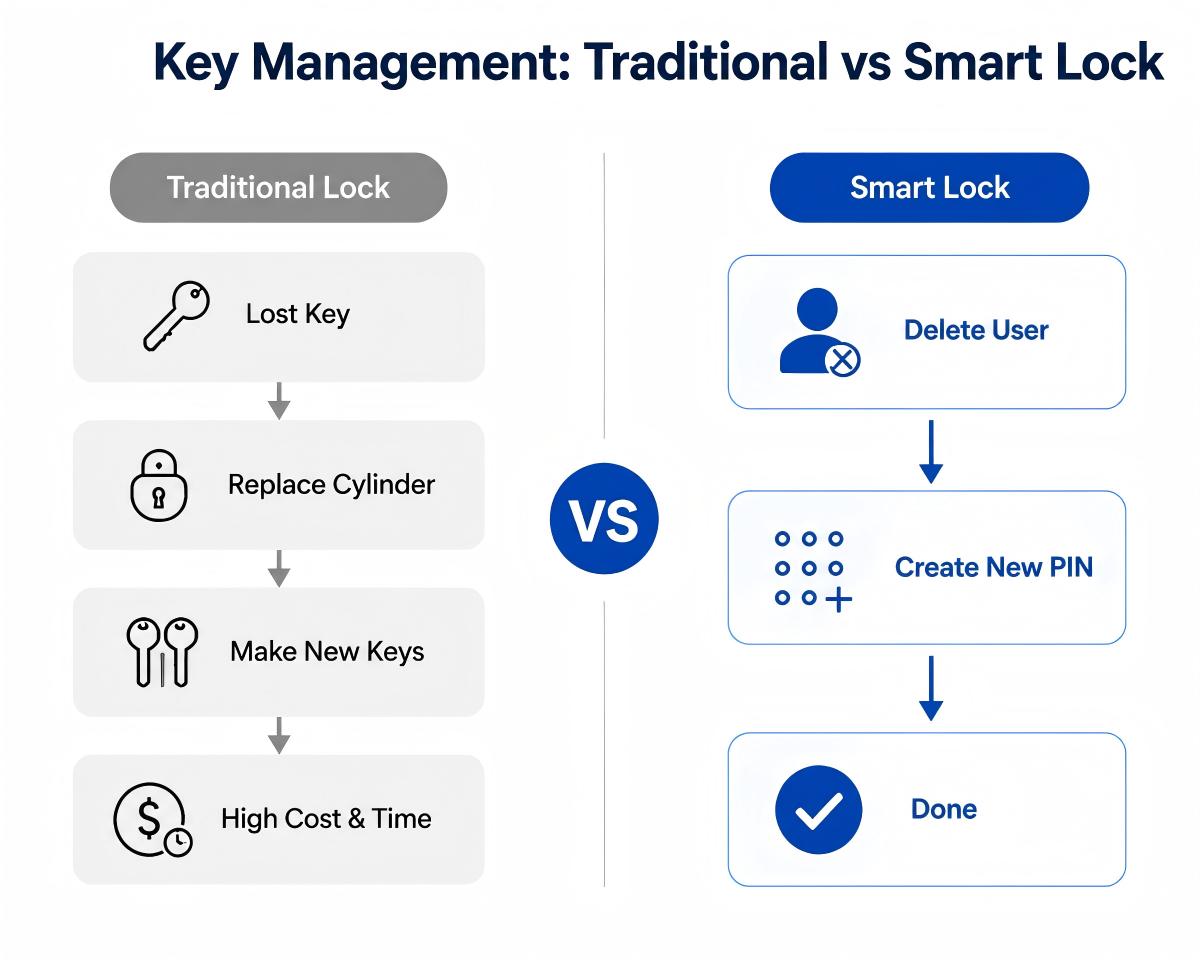
| Scenario | Traditional Lock | Smart Lock |
|---|---|---|
| Lost Access Credential | Lost physical key | Delete digital user access |
| Recovery Process | Replace cylinder and make new keys | Create new PIN or update access permissions |
| Time Required | Time-consuming process | Completed within minutes |
| Management Cost | Higher maintenance cost | Lower cost with digital management |
Although both products serve the same purpose—protecting doors—they differ significantly in functionality, user experience, and long-term value.
Access Method
A traditional deadbolt depends entirely on a mechanical key.
If the key is unavailable, users cannot unlock the door without assistance.
A smart door lock supports multiple authentication methods, allowing users to choose the most convenient option depending on the situation.
For example, a homeowner may unlock the door using fingerprint recognition during daily use, while providing a temporary PIN code for a guest.
This flexibility is one of the biggest reasons why many customers searching for smart lock vs key lock ultimately choose smart locking systems.
User Management
Traditional locks provide no practical way to distinguish between different users.
Once multiple copies of a key exist, controlling access becomes increasingly difficult.
Smart locks solve this issue through digital credential management.
Administrators can:
-
Add new users
-
Delete former employees
-
Disable lost RFID cards
-
Change PIN codes instantly
-
Grant temporary access
This feature is especially valuable for:
-
Apartment management companies
-
Hotels
-
Offices
-
Coworking spaces
-
Rental properties
Business Value for Wholesalers
From a wholesaler's perspective, the comparison between smart locks vs regular locks extends beyond product features.
Smart locks typically provide:
-
Higher average selling prices
-
Better profit margins
-
Increased demand in modern construction projects
-
Additional accessory sales (gateways, RFID cards, software services)
As smart home adoption continues to expand globally, distributors who invest in smart lock product lines are better positioned to capture future market growth.
3. Convenience & Key Management Costs
Convenience has become one of the strongest selling points when comparing smart lock vs regular lock solutions.
Traditional locks require customers to manage physical keys throughout the entire lifecycle of the property.
Common challenges include:
-
Replacing lost keys
-
Duplicating keys for family members
-
Rekeying locks after tenants move out
-
Coordinating key handovers
Each of these tasks consumes time and increases operating costs.
Smart locks dramatically simplify access management.
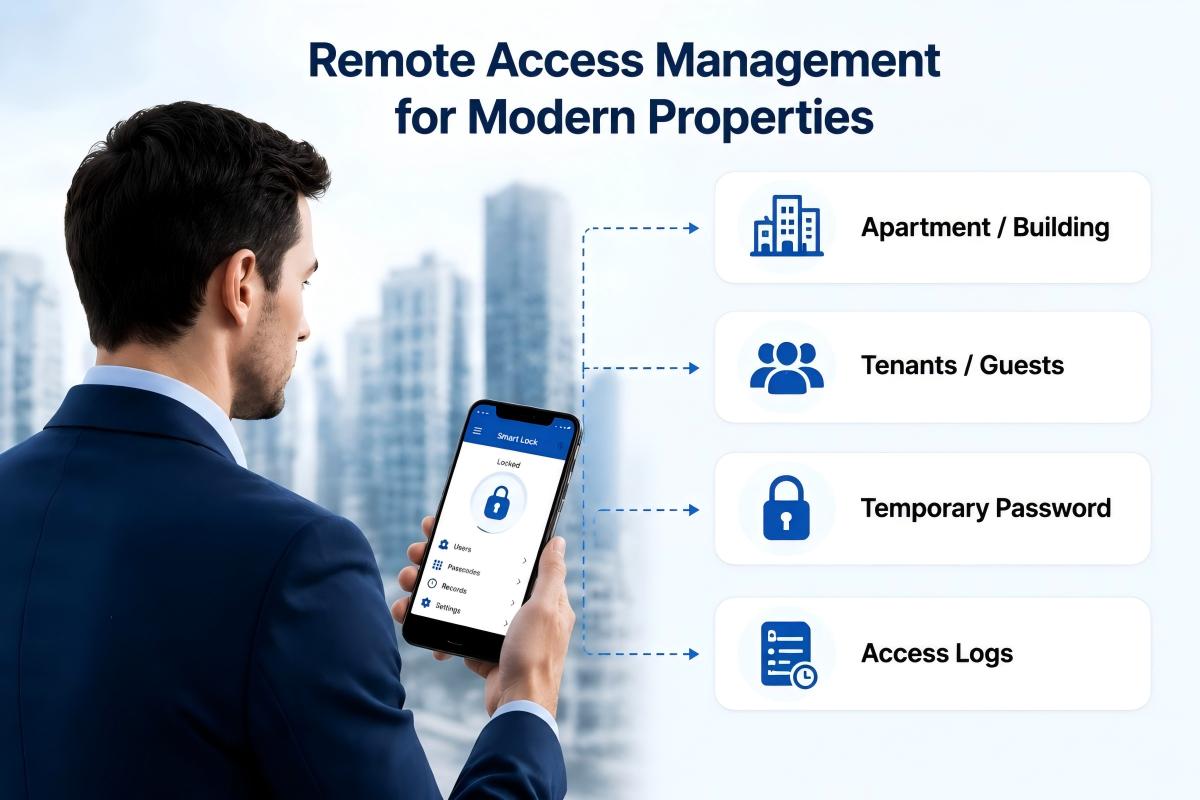
Instead of relying on metal keys, property owners can issue digital credentials in seconds using a mobile application.
For wholesalers serving property management companies, this creates a compelling business case.
Imagine managing hundreds of apartment units after tenant turnover. Rather than replacing lock cylinders and distributing new keys, managers simply remove the previous tenant's digital access and issue new credentials to incoming residents.
This process not only reduces labor costs but also improves security by eliminating unauthorized duplicate keys.
Furthermore, smart locks equipped with Tuya WiFi or TTLock platforms allow remote access management, making them ideal for Airbnb hosts, serviced apartments, hotels, and office buildings where flexible access control is essential.
4. Durability Comparison: Smart Lock vs Traditional Deadbolt
|
Durability Feature
|
Traditional Deadbolt
|
Smart Door Lock
|
|---|---|---|
|
Waterproof Design
|
❌ Not Available
|
✅ Waterproof
|
|
Body Material
|
❌ Standard Metal Structure
|
✅ Aluminum Alloy Body
|
|
Anti-corrosion Protection
|
❌ No Anti-corrosion Treatment
|
✅ Anti-corrosion Treatment
|
|
Emergency Power Supply
|
❌ Not Supported
|
✅ Emergency Power (USB Type-C)
|
|
Mechanical Key Backup
|
✅ Supported
|
✅ Supported
|
|
Overall Durability
|
Basic Mechanical Protection
|
Durable & Smart Security Solution
|
Durability is another important consideration for wholesalers when evaluating smart locks vs traditional locks. Many buyers assume that because smart locks contain electronic components, they are less durable than conventional deadbolts. In reality, today's commercial-grade smart locks are engineered to perform reliably in demanding environments.
Traditional Deadbolts
Traditional deadbolts are known for their robust mechanical construction. With fewer moving parts and no electronics, they can provide years of dependable service with minimal maintenance.
However, traditional locks are still susceptible to:
-
Key wear over time
-
Mechanical cylinder damage
-
Corrosion in harsh environments
-
Lock replacement after key loss
Although the lock body itself may last for many years, the ongoing maintenance associated with physical keys often increases the total cost of ownership.
Modern Smart Door Locks
High-quality smart locks are specifically designed for long-term daily use in residential and commercial applications.
A premium smart lock typically features:
-
Aluminum alloy or zinc alloy housing
-
Anti-corrosion surface treatment
-
IP65 or IP66 waterproof protection
-
Scratch-resistant finish
-
High-cycle fingerprint sensor
-
Long battery life
-
Emergency USB power supply
-
Mechanical backup key
These features ensure reliable operation in apartments, offices, villas, hotels, and outdoor entrances.
For wholesalers serving international markets, selecting products with strong weather resistance is especially important, as environmental conditions vary significantly between regions.
Battery Life Is No Longer a Concern
One of the most common questions customers ask is:
"What happens if the battery runs out?"
Modern smart locks have effectively solved this concern.
Most models provide:
-
Low battery warning notifications
-
Several weeks of standby after low-battery alerts
-
Emergency Type-C or USB power interface
-
Mechanical backup key
This ensures users are never locked out simply because the batteries are depleted.
Long-Term Maintenance Costs
From a distributor's perspective, maintenance costs directly affect customer satisfaction.
Compared with traditional locks, smart locks reduce expenses related to:
-
Key duplication
-
Lock cylinder replacement
-
Lost key management
-
Locksmith services
Instead of replacing hardware, administrators can simply delete a digital credential and issue a new one within seconds.
As a result, smart locks often deliver lower lifetime operating costs despite a higher initial purchase price.
5. Why Property Managers Are Switching to Smart Locks
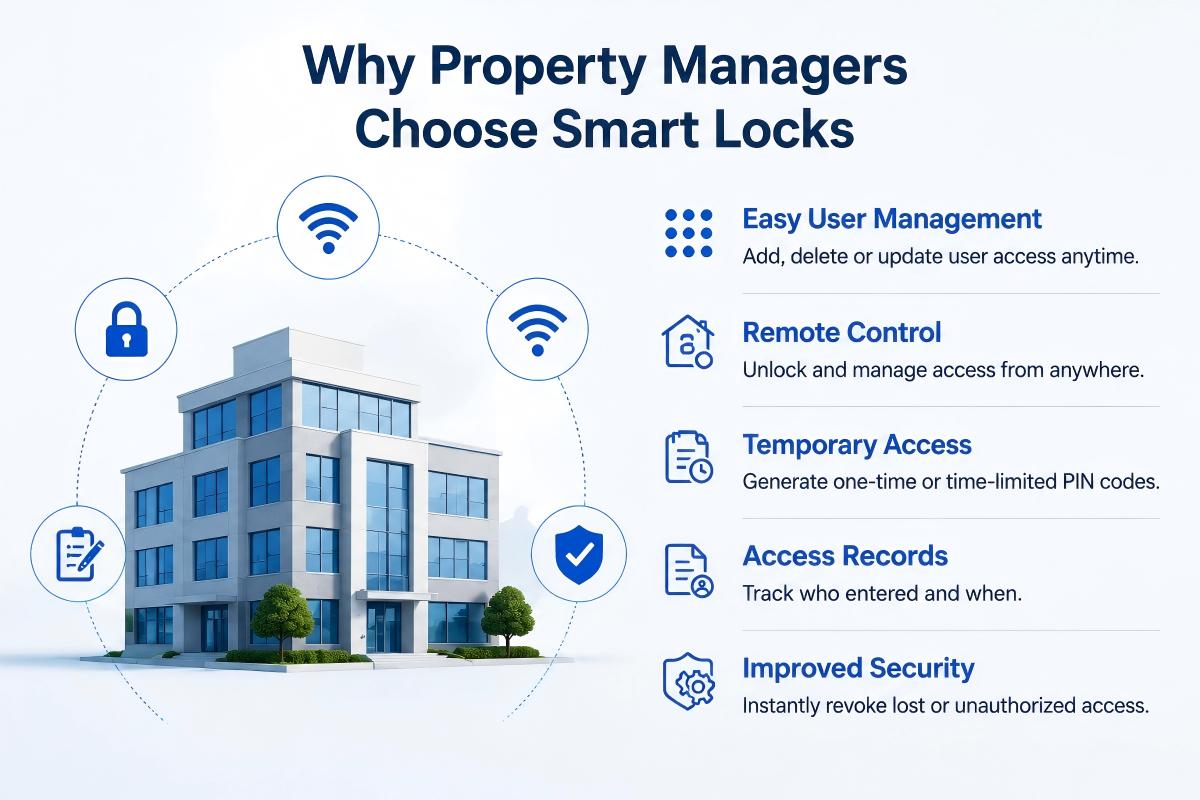
Property management companies worldwide are increasingly adopting smart locks to improve efficiency, security, and tenant experience.
Simplified Tenant Management
Traditional keys require manual collection, rekeying, or lock replacement when tenants change.
With smart locks, managers can simply remove old digital credentials and assign new access permissions within minutes.
Remote Access Management
WiFi-enabled smart locks allow administrators to manage properties remotely, including:
-
Remote unlocking;
-
Creating temporary PIN codes;
-
Updating user permissions;
-
Monitoring access activity.
This helps reduce management costs and improves operational efficiency for rental apartments, vacation homes, and offices.
Better Guest Experience
Smart locks simplify self-check-in for short-term rentals and hospitality businesses.
Guests can receive temporary PIN codes or mobile access before arrival, eliminating the need for physical key handovers.
Enhanced Security
Unlike traditional keys, digital credentials can be updated or removed instantly.
When tenants or employees leave, administrators can disable access immediately without replacing locks, reducing the risk of unauthorized entry.
Smart locks provide property managers with a smarter, more flexible, and scalable access control solution for modern buildings.
6. Why Choose Secukey as Your Smart Lock Partner?
Secukey specializes in smart access control solutions, providing wholesalers, distributors, and system integrators with reliable products and flexible OEM services.
Our solutions include:
With experience in international markets, Secukey helps partners provide modern security solutions for residential and commercial applications.
Whether you are expanding your smart home product line or looking for an experienced smart lock OEM manufacturer, Secukey is ready to support your business growth.
Conclusion
Traditional deadbolt locks have served the market for decades, but the future of security is moving toward intelligent, connected, and manageable solutions.
For wholesalers, distributors, and security professionals, smart door locks represent not only a product upgrade but also a valuable business opportunity.
Partnering with the right smart lock supplier can help you meet changing customer expectations and stay competitive in the growing smart security market.
Looking for a reliable smart lock OEM supplier?
Contact Secukey today to explore wholesale smart lock solutions for your market.
Contact Secukey today to explore wholesale smart lock solutions for your market.