

2026-09-08
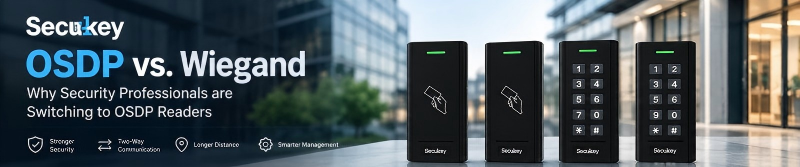
OSDP vs. Wiegand: Why Security Professionals are Switching to OSDP Readers
1. The Security Flaws of Wiegand Protocol
The biggest limitation when comparing Wiegand protocol vs. OSDP is communication security.
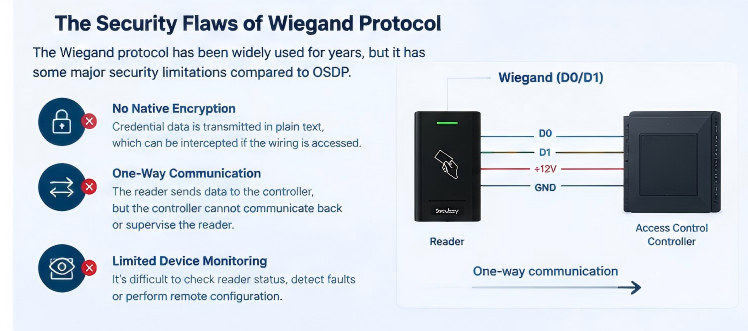
Traditional Wiegand uses a simple interface to transmit credential data from the reader to the access control controller. The commonly used D0 and D1 data lines transmit the card or credential information, while the reader itself does not establish an encrypted communication channel with the controller.
This simple architecture has been reliable for basic access control applications, but it was not designed for today's higher security requirements.
Wiegand Does Not Provide Native Encrypted Communication
Traditional Wiegand communication does not provide built-in encryption between the reader and controller.
If someone gains physical access to the communication wiring, the transmitted data may be vulnerable to interception. This is particularly important for commercial buildings, critical infrastructure, corporate facilities, and other installations where access control security is a priority.
Wiegand Is Primarily One-Way Communication
Another limitation of Wiegand is its simple one-way communication model.
The reader sends credential data to the controller, but the controller has limited ability to communicate back with and supervise the reader.
This means traditional Wiegand systems have fewer options for:
-
Reader status monitoring
-
Device supervision
-
Remote configuration
-
Advanced reader management
-
Secure communication
This difference becomes especially important when comparing Wiegand vs. OSDP for larger or security-sensitive access control projects.
Why This Matters for Modern Access Control
Wiegand is still suitable for many existing installations, especially where a controller already supports Wiegand and the application does not require encrypted reader communication.
However, for new projects, security professionals increasingly want a communication protocol that can do more than simply transmit a credential number.
That is one of the main reasons OSDP is gaining attention.
2. What Is an OSDP Reader?
So, what is an OSDP reader?
An OSDP reader is an access control reader that communicates with an access control controller using the Open Supervised Device Protocol (OSDP).
Unlike traditional Wiegand, OSDP is based on RS-485 communication and supports bidirectional communication between the reader and controller.
This allows the controller to communicate with the reader, monitor its status, and support additional security functions.
In other words, an OSDP reader is not simply a device that sends card data to a controller. It can become an actively supervised device within the access control system.
Key Advantages of OSDP Readers
Compared with traditional Wiegand readers, OSDP can provide several important advantages:
-
Bidirectional communication
-
Device supervision
-
Secure communication through OSDP Secure Channel
-
AES-128 encryption
-
RS-485 communication
-
Multi-drop capability
-
Greater flexibility for system integration
For access control manufacturers and system integrators, these capabilities make OSDP particularly attractive for modern security systems.
Secukey provides several OSDP reader options for access control applications.